
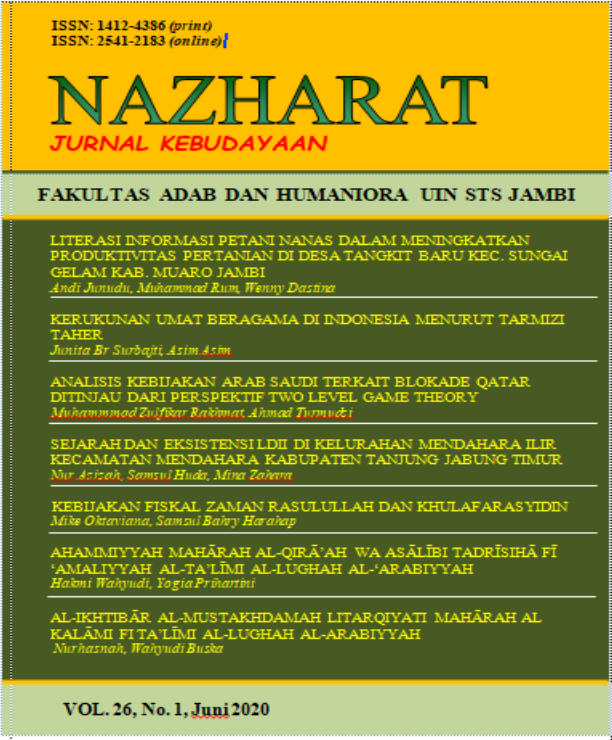
KERUKUNAN UMAT BERAGAMA DI INDONESIA MENURUT TARMIZI TAHER
Keywords:
Kerukunan, Tarmizi Taher, Masyarakat Beragama;Abstract
Isu keberagaman masyarakat di Indonesia menjadi tema menarik sepanjang sejarah, terlebih ketika berbicara mengenai kerukunan umat beragama dalam masyarakat multi kultur. Keberagaman agama akan menjadi kekuatan bangsa manakala agama-agama mampu hidup berdampingan secara menyenangkan dalam sebuah negara. Namun, keberagaman dapat memicu konflik ketika masyarakat memaksakan kebenaran agamanya di tengah keberagaman agama. Salah satu tokoh yang paling konsen dalam menciptakan kerukunan umat beragama di Indonesia adalah Tarmizi Taher. Melihat situasi keberagaman masyarakat di Indonesia, Tarmizi Taher berpendapat bahwa kerukunan antar umat beragama dapat diwujudkan jika masing-masing agama mengakui prinsip umum sebagai landasan bersama dalam merespon situasi keanekaragaman.
Downloads
Published
Issue
Section
License
License and Copyright Agreement
By submitting a manuscript to Nazharat: Jurnal Kebudayaan, authors confirm that the work is original, has not been previously published (except in permitted forms), and is not under consideration by another journal. Authors also certify that all co-authors and relevant institutions have approved the publication and that permission has been obtained for any previously published or copyrighted materials used in the manuscript. Authors retain the copyright of their published works while granting the journal the right of first publication.
All articles published in Nazharat: Jurnal Kebudayaan are licensed under the Creative Commons Attribution-NonCommercial-ShareAlike 4.0 International License (CC BY-NC-SA 4.0). This license permits readers to access, read, download, copy, distribute, and adapt published works for non-commercial purposes, provided that appropriate attribution is given and derivative works are distributed under the same license. Authors are also permitted and encouraged to deposit, share, and republish their manuscripts through personal websites, institutional repositories, and other academic platforms, provided that the original publication in Nazharat: Jurnal Kebudayaan is properly acknowledged. Further information is available at Creative Commons CC BY-NC-SA 4.0.