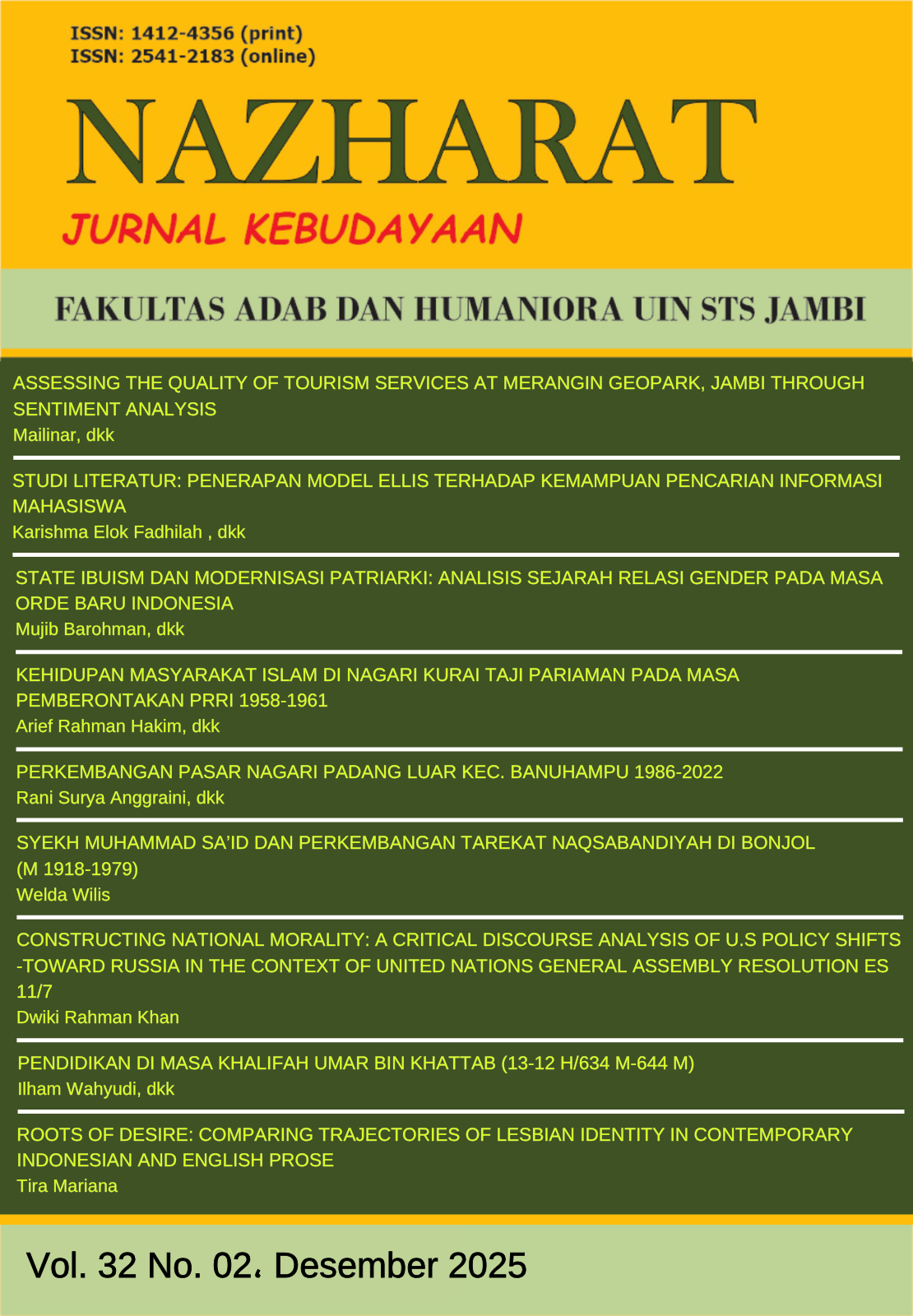
STATE IBUISM DAN MODERNISASI PATRIARKI: ANALISIS SEJARAH RELASI GENDER PADA MASA ORDE BARU INDONESIA
DOI:
https://doi.org/10.30631/nazharat.v32i2.239Keywords:
State Ibuis, Patriarchy, Women HistoryAbstract
This study analyzes how the New Order regime under President Soeharto (1966–1998) systematically transformed gender relations in Indonesia through state ibuism, an ideology and institutional apparatus that defined and mobilized women primarily as wives and mothers. This Study using historical methodology and primary sources government documents, laws, official speeches, and statistical datathe research examines the continuities and discontinuities between colonial and Old Order patriarchal structures and those of the New Order, as well as the mechanisms that enabled the regime to construct a more systematic and penetrative form of patriarchy. The findings show that state ibuism modernized and bureaucratized previously diverse, localized, and informal patriarchal norms into a national, institutionalized, and legally codified system. This transformation operated through three synergistic mechanisms: institutionalization, legalization (the and ideologization . Conceptualized as modern state patriarchy, state ibuism incorporated women into public life while reinforcing domestic subordination producing mobilization without emancipation. Situated within developmental authoritarianism, the study demonstrates how gender governance supported population control, labor exploitation, and social stability. Despite the fall of the New Order, the persistence of PKK structures, the endurance of the Marriage Law’s patriarchal provisions, and ongoing appeals to women’s nature indicate the deep institutional and ideological legacy of state ibuism. The study contributes to scholarship on gender and authoritarianism and suggests future research on women’s lived experiences, regional variations, intersectional dynamics, and comparative developmental states.
Downloads
Published
Issue
Section
License
Copyright (c) 2025 Mujib Barohman, Imam Muhsin

This work is licensed under a Creative Commons Attribution-NonCommercial-ShareAlike 4.0 International License.